Oguchi
The Earthquake BirdOguchi is a young police officer who joins Kameyama in questioning Lucy Fly about Lily Bridges. His role is modest but revealing: he watches Lucy, offers small courtesies, and asks a few questions, while the interrogation’s meaning remains unsettled by what she withholds and what she later invents. Seen chiefly through Lucy’s attention, he is both an official presence and an awkward, fallible person under observation.
Identity and Introduction
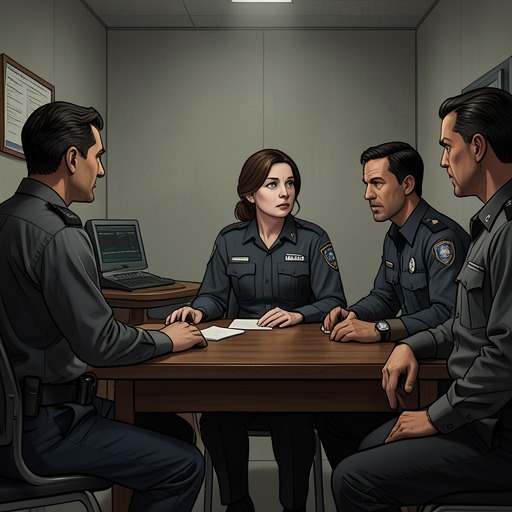
Kameyama opens the interview-room door and brings Oguchi in as a second officer. Lucy reads their name badges: Kameyama is the older investigator, while Oguchi is young, with soft, hairless arms and a stoop she compares to that of a teenager who has grown too quickly. He sits farther back than Kameyama and appears worried. From the beginning, the scene gives him a physical presence before it gives him much authority in the questioning.
His unease comes through a succession of small movements. He plays with the left knee of his trousers, scratches his long, bony nose, and lets his eyes dart around the room without meeting Lucy’s gaze. When a mosquito lands on his neck, he tries to ignore it; as it approaches his face, he smashes his hands together more violently than necessary, then wipes the insect away on a white handkerchief. He turns toward the door, apparently hoping Kameyama will return, and Lucy notices that he is blushing. Her thought that he may fancy her is her interpretation, not an established fact about him.
Conduct in the Interrogation
Left alone with Lucy while Kameyama is away, Oguchi writes in a notepad and waits. Lucy is preoccupied with her future and with memories of Teiji; the interview does not command her attention. When Oguchi watches her, he pours her a glass of water. She accepts the gesture gratefully, though she wonders whether it is simply a right guaranteed by the Japanese constitution. Hot and uncomfortable, she dips her fingers in the glass and wipes water across her face. Oguchi seems to take this as a sign that they have begun to make contact.
His first reported question is about Lucy’s time in Japan: “You have been in Japan a long time. Nine years?” The question leaves her unsure whether he is pursuing the official interview or making conversation. Her uncertainty matters: even a straightforward inquiry does not settle the character of the encounter for her. She is conscious that what she says may be recorded and used as evidence, while Oguchi’s manner can seem personal as well as procedural.
When Kameyama returns, he and Oguchi stare at Lucy together. Kameyama insists that she must tell him about Bridges and reminds her that they know she knew Lily well. Oguchi is present for this demand, but the pressure in the exchange is voiced by Kameyama. Lucy acknowledges the friendship, then qualifies it inwardly: she had not known Lily well enough. Oguchi’s place in the room is thus partly that of a witness to Lucy’s pauses and evasions, rather than the principal interrogator.
Lucy’s Readings and Deflections
Oguchi’s attention is filtered through Lucy’s unsettled perspective. She watches him fidget, notices when he looks away, and imagines his embarrassment or attraction. At the same time, her own attention repeatedly leaves the interview for remembered scenes with Teiji and for thoughts of Lily. The contrast makes Oguchi seem vulnerable to her scrutiny even as she is the person being questioned. His anxious physicality is concrete; the motives Lucy assigns to it remain uncertain.
The exchange about hobbies is one of the few occasions when Oguchi directly puts a personal question to her. He asks, “No hobbies at all?” and gives her a look Lucy describes as almost a cry. She replies, “None. I don’t need hobbies. That doesn’t make me a murderer, though.” Oguchi clears his throat and says nothing. Lucy turns a question about ordinary interests into a challenge about the case, making the possibility of guilt explicit while refusing to offer the conversational answer he may have expected. His flustered silence leaves her accusation unanswered.
The Confession and Its Limits
The interview takes place in a period when Lucy says she is not ready to talk. She cannot yet recover what happened on the night in question and insists that the memory is blurred; Kameyama will have to wait while she tries to bring it back. Oguchi, meanwhile, rubs the other trouser knee and picks at its seam. Their shared silence becomes charged when Lucy fixes her eyes on him. She thinks the horror of the crime she may have committed is beginning to register on his face, but he searches for a question and she does not answer. The scene shows how little can safely be concluded from what either officer—or Lucy—appears to read in another person’s expression.
Later, Lucy gives the police a fluent account of killing Lily: jealousy, rage, obsessive love for Teiji, a pair of stockings used as a weapon, and Lily’s body being dragged to a hiding place. The account is detailed, but Lucy identifies it as a story she has made up, not a true confession. She says she did not kill Lily, while also describing herself as not entirely innocent because of her part in the events leading to Lily’s visit. The police subsequently release her without charges: the case is circumstantial, investigators find no fingerprint or DNA sample on Lily’s body, and new evidence changes their understanding of the night. Oguchi’s own response to the confession or release is not specified; the narrative does not make him the source of the evidence or the judge of Lucy’s credibility.
Narrative Role
Oguchi’s importance lies in the gap between the institutional setting and Lucy’s unstable account of it. He is part of the police presence, but the details that define him are gestures—a handkerchief, a glass of water, a restless knee, a throat cleared without an answer. Those gestures give the interview a human, awkward texture without proving what he thinks. Lucy’s speculation about his attraction, her awareness of his embarrassment, and her resistance to his questions all pass through her perspective, which also admits gaps in memory and a capacity to invent.
As an interviewer, Oguchi asks little in the evidence shown, and his brief exchanges do not resolve the case. He instead helps frame the tension between questioning and knowing: Lucy is watched, yet she watches him in return; she appears to confess, yet later distinguishes her story from the truth. His uncertain presence underscores the limits of reading guilt from demeanor or fluency, especially in an interrogation where the account itself may be unreliable.